
August 24, 2026
How NationsUniversity Approaches Scripture: Exegesis Before Theology
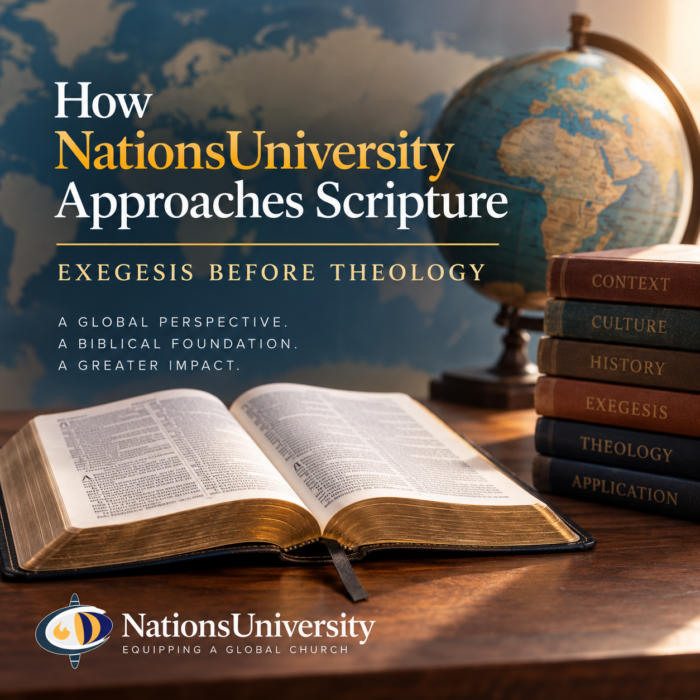
What happens when we set aside our cultural and theological assumptions and allow Scripture to speak for itself? NationsUniversity founder Dr. Mac Lynn believed serious biblical study begins with the text—not with the conclusions we bring to it.
Every student comes to the Bible carrying something.
We bring our culture, church traditions, theological vocabulary, denominational assumptions, personal experiences, and the conclusions of teachers who came before us. For students in the Western world, we also inherit centuries of Western ways of organizing, explaining, and debating Christian theology. Many churches and colleges claim to use an exegetical approach to Scripture, but in practice, they often begin with established theological conclusions and use Scripture to support them. True exegesis reverses that process, allowing the biblical text to shape, challenge, and, when necessary, correct our theology.
These influences are not necessarily bad. Tradition can preserve wisdom. Theology can help us organize what we believe. Scholarship can illuminate the historical and literary world of Scripture.
But NationsUniversity founder and longtime chancellor Dr. Mac Lynn recognized an important danger: We can become so accustomed to looking at Scripture through inherited theological and cultural frameworks that we no longer recognize the difference between what the Bible says and what we have been taught that it says.
That conviction helped shape NationsUniversity’s approach to Scripture and biblical education by teaching students to conduct exegesis before theology.
Two Assumptions About Scripture
Students sometimes ask what assumptions NationsUniversity brings to its study of the Bible.
Broadly speaking, two very different starting points are possible.
One begins with the assumption that the biblical text is historically trustworthy and that its message remains relevant when understood within its proper context. The other begins with the assumption that the text is fundamentally flawed or biased and that its relevance must ultimately be determined by human judgment.
NationsUniversity begins with the first.
That does not mean every interpretation of Scripture is correct. In fact, confidence in Scripture makes careful interpretation even more important.
Students must be willing to engage the biblical text with openness, intellectual honesty, and a willingness to investigate their own assumptions.
Instead of beginning with “What have I been taught to believe about this passage?” the student learns to ask “What does this passage actually say?”
That distinction is fundamental to the NationsUniversity educational philosophy.
Exegesis Before Theology
Prospective students sometimes ask, “But what does NationsUniversity teach?”
Often, there is another question behind it: Will NationsUniversity teach the theological positions I already believe?
NationsUniversity begins somewhere else.
Theology matters, but theology is the result of interpreting Scripture. It should not determine the interpretation before serious examination of the biblical text has begun.
If we begin with a theological conclusion and then search Scripture for passages that support it, we risk making the text conform to our theology.
NationsUniversity seeks to reverse that process:
Scripture → Exegesis → Theology → Application
Begin with Scripture. Examine a passage within its literary, historical, cultural, and biblical contexts. Determine what the text permits us to conclude. From sound exegesis, develop theological understanding. Then ask how that biblical message should be applied.
This does not require students to enter the classroom without theological beliefs. No one approaches Scripture completely free of assumptions.
Instead, students learn to recognize those assumptions and become willing to test them against Scripture.
Our theology can be a hypothesis. Scripture must be allowed to test it.
Looking Beyond Western Paradigms
This principle was particularly important to Mac Lynn because NationsUniversity was conceived as a global university.
Christianity did not originate in the modern West, and the Bible was not written by modern Americans or Europeans.
Abraham did not think like a twenty-first-century American. The apostles did not organize their world according to modern Western categories. The biblical writers lived within ancient cultures with languages, customs, literary conventions, social structures, and ways of understanding the world that can be significantly different from our own.
Yet all readers naturally interpret what they encounter through the world they know.
Western Christians can therefore unknowingly bring Western assumptions about individualism, institutions, politics, economics, education, philosophy, and religion into texts written within very different cultural settings.
Mac Lynn wanted NationsUniversity students to learn to recognize those lenses.
Stripping away Western paradigms does not mean rejecting Western scholarship, abandoning Christian tradition, or dismissing centuries of Christian thought.
It means refusing to give our culture—or any culture—the authority that belongs to Scripture.
The goal is to encounter the biblical text as nearly as possible within its world before translating its message into ours.
Scripture Must Also Test Our Traditions
Culture is not the only source of assumptions. Christians also inherit theological traditions.
Across the centuries, Christians have developed theological systems, denominations, confessions, and traditions. Many have made important contributions to our understanding of the Christian faith.
But theological positions can also acquire authority simply because they have been repeated for generations.
Eventually,
“This is how our tradition understands Scripture”
can quietly become
“This is what Scripture says.”
Those statements are not necessarily the same.
NationsUniversity therefore encourages students to examine inherited conclusions critically. A belief should not be accepted merely because it is old, familiar, popular, or denominationally approved. Neither should it be rejected for those reasons.
The essential question remains:
Can this conclusion be justified by the biblical text?
Serious biblical study sometimes confirms what we have always believed. At other times, it may require us to refine a belief, reconsider an assumption, or acknowledge that Scripture is more complex than the theological categories we inherited.
That is not a failure of biblical education. It is part of its purpose.
One Bible, a Global Classroom
This approach helps explain why NationsUniversity can serve students from remarkably diverse cultural and religious backgrounds.
If a university begins with a distinctly Western theological framework and requires students around the world to adopt it before studying Scripture, biblical education can easily become the exportation of a particular Christian culture.
Mac Lynn envisioned something different.
Students in Africa, Asia, Europe, Latin America, the Middle East, and North America come to Scripture from very different backgrounds. Each brings questions and assumptions shaped by culture, community, and experience.
The common ground is not a Western theological tradition.
The common ground is Scripture.
A global learning community can even help expose assumptions that students did not realize they possessed. Something one culture considers “obviously biblical” may turn out to be partly cultural when examined alongside Scripture and the perspectives of Christians from another part of the world.
The principle applies equally to everyone.
Western students have cultural assumptions. Non-Western students have cultural assumptions.
The goal is not to replace a Western lens with another cultural lens. The goal is to teach every student to recognize the lenses they bring to Scripture.
Learning to Listen Before We Speak
Ultimately, NationsUniversity’s approach to Scripture requires both intellectual and spiritual humility.
Students learn to resist the temptation to make Scripture answer their questions before they have listened carefully to what Scripture is saying.
They learn to distinguish between the biblical text, their interpretation of the text, and the theological conclusions they draw from that interpretation.
And they must remain willing to reconsider those conclusions when careful exegesis requires it.
Only then are students prepared to move toward application.
What did the biblical text communicate within its original setting?
What theological implications legitimately arise from it?
And how should that message shape Christian faith, ministry, and practice today?
This is why the NationsUniversity approach to Scripture cannot be reduced simply to a list of theological positions.
NationsUniversity certainly has convictions about the Bible. But its educational mission goes beyond telling students what conclusions they should reach.
We seek to teach students how to read, investigate, exegete, test inherited assumptions, and allow Scripture itself to shape their theology and ministry.
That was central to Mac Lynn’s vision for NationsUniversity: not simply exporting Western Christianity to the world, but equipping students around the world to engage faithfully with the biblical text and discover its power and relevance within their own contexts.
Hear Dr. Mac Lynn Explain the NationsUniversity Approach
Why was NationsUniversity’s curriculum developed this way? And why did Mac Lynn believe beginning with the biblical text was so important?
Watch Chancellor Dr. Mac Lynn explain the philosophy behind the NationsUniversity curriculum and the university’s distinctive approach to studying Scripture.
Ready to Study Scripture More Deeply?
NationsUniversity offers accessible, accredited online biblical education designed for students who want to deepen their knowledge of Scripture and prepare for more effective Christian service.
Explore NationsUniversity’s degree and certificate programs and discover how serious study of Scripture can equip you for ministry and lifelong service.